



Understanding a Handwritten Will in Manitoba
A handwritten will in Manitoba can be legally valid. These are known as holographic wills, and unlike “traditional” wills they do not require witnesses or formal drafting.
At first, this seems convenient. You can write your wishes down, sign the document, and assume everything is settled. However, that assumption often creates problems later.
In reality, these wills frequently raise legal questions that only a court can resolve.
When Are Handwritten Wills Valid?
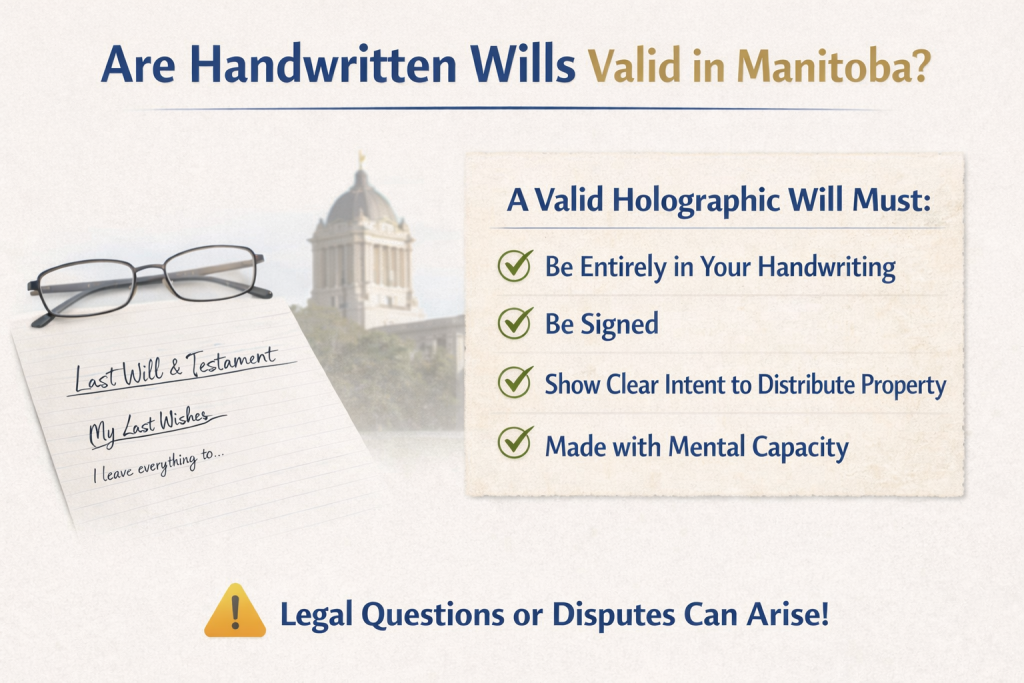
To be valid, a handwritten will in Manitoba must:
- Be entirely in your handwriting
- Be signed
- Clearly show your intention to distribute your property after death
- Be made while you have mental capacity
The law focuses on intention. In other words, the court asks whether you meant the document to function as your final will.
However, intention is not always obvious. As a result, even simple wording can lead to disputes.
For more information about estate planning, visit our Estate Planning page.
Common Problems With Handwritten Wills
Handwritten wills often create issues, even when they appear straightforward.
For example, problems arise when the document:
- Uses vague language
- Leaves out key details
- Fails to name someone to manage the estate
- Conflicts with another document
As a result, families may face delays, added costs, or disagreements.
You can also explore related disputes on our Estate Litigation page.
Case Example: What Happened in Blustein Estate
A recent Manitoba Court of King’s Bench case, Blustein Estate, 2025 MBKB 60, provides a useful example.
In this case, the deceased left behind two handwritten notes, one from 1972 and another from 1994. Both were signed and written entirely in her handwriting.
Each note suggested that her estate should go toward charitable purposes. However, neither document explained how those wishes should be carried out in practice.
If the notes had been found invalid, the estate would have gone to distant relatives under intestacy laws.
How the Court Handled the Handwritten Will
The court confirmed that the handwritten will was valid under Manitoba law.
Specifically, it found that:
- Both notes showed clear intent
- The later note replaced the earlier one
- There was no strong evidence to challenge capacity
However, a practical issue remained.
The will directed that the estate fund scholarships for the needy. At the same time, it did not name an organization to manage those funds.
Therefore, the court stepped in. It ordered that the estate be used to create an endowment with The Winnipeg Foundation so the intention could be carried out.
You can read the full decision here:
https://www.canlii.org/en/mb/mbkb/doc/2025/2025mbkb60/2025mbkb60.html
What This Means for You
This case reflects a common situation.
The intention may be clear. However, the details are often incomplete.
As a result:
- Courts may need to interpret your wishes
- Your estate could face delays
- Costs may increase
- Outcomes may depend on judicial decisions
A properly drafted will avoids these issues because it addresses both intention and execution from the start.
Final Thoughts on Handwritten Wills in Manitoba
Writing a will by hand feels simple. It also feels personal.
However, that simplicity can create complications later. Even when a handwritten will in Manitoba is valid, it often leaves unanswered questions.
Clarity, in this context, matters more than convenience.
Need Help With a Will?
If you are considering a handwritten will in Manitoba or want to ensure your estate plan is clear and enforceable, Tradition Law LLP can help.